Summary
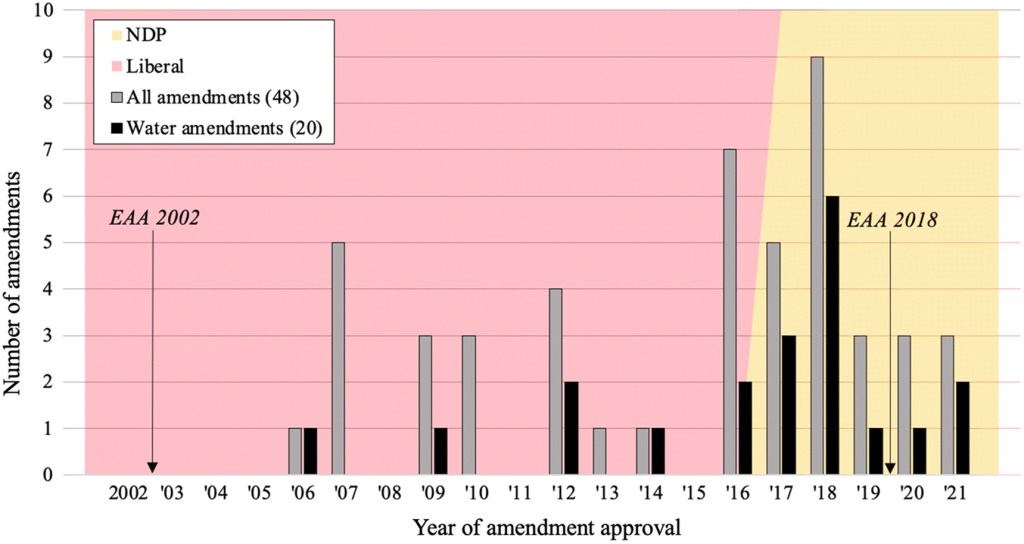
There is a little-known clause in British Columbia’s Environmental Assessment Act that can allow a company to make significant physical changes to their natural resource extraction projects after the conclusion of an environmental assessment (EA). This process is known as an ‘amendment,’ and occurs with less scientific and public scrutiny than the original EA. We used mining projects as an example to investigate how often amendments were occurring and what types of predicted impacts they could have on freshwater resources throughout BC. First, we dug through hundreds of pages of documents posted on BC’s EA project registry to pick out key information related to project amendments, then conducted quantitative and qualitative analyses to break down trends across BC as related to potential freshwater impacts from mining.
We found that of the 23 mines approved under BC’s EA process between 2002 and 2020:
- 14 mines (61%) were granted amendments after-the-fact, with some mines receiving up to seven amendments. Most mines applied for their first project amendment within 3 years of initial EA approval.
- 10 mines (43%) were granted amendments likely to harm freshwater resources, including increased discharge of effluent into river systems, destruction of wetlands, and extraction of groundwater.
- 48 out of 49 (98%) amendments that were requested were subsequently approved.
Mining project amendment documents generally lacked specific, quantitative information to reinforce claims or decisions, and requirements for public or expert scrutiny were lower than the initial EA process. We expressed concern that amendments for mining projects in BC present a case of “path dependency” in environment decision-making where an initial EA decision sets precedent for mines to expand over time, undermining the intent and credibility of EA laws.
Products
Journal Article
Collison et al., 2022
FACETS
IAIA 2022 Conference Slides
Media Coverage
Environmental safeguards at B.C. mines are being eroded by amendments
by Bob Weber, The Canadian Press
CBC, 2022
B.C. mine environment safeguards whittled down by amendments, university study says
by Bob Weber, The Canadian Press
Global News, 2022

A community transformed from mining town to resort destination. It doesn’t want to go back
by Francesca Fionda
The Narwhal, 2023
People

Dr. Alana Westwood
PI / Supervisor,
SRES at Dalhousie University

Ben Collison
Lead Researcher,
SRES at Dalhousie University

Patrick Reid
Research Team,
SRES at Dalhousie University

Hannah Dvorski
Research Team,
SRES at Dalhousie University

Mauricio Lopez
Research Team,
SRES at Dalhousie University

Nikki Skuce
Partner,
Northern Confluence Initiative
Funding and Contribution




 Westwood Lab