Summary
In 2019, the federal government of Canada implemented the Impact Assessment Act (IAA) to broaden the scope of assessment of major infrastructure and natural resource development projects (RDPs) to include additional social, health, cultural, and environmental impacts (Government of Canada, 2019a). The new updates emphasize Gender-Based Analysis Plus (GBA+), an analytical tool defined as “a […] process used to assess how diverse groups of […] people of all genders may experience policies, programs, and initiatives” (Government of Canada, 2022). The addition of GBA+ has been pushed to the forefront by Indigenous women and scholars, scientists, and activists highlighting the negative experiences of those who have been simultaneously excluded from Impact Assessment (IA) processes and harmed by RDPs (Manning et al., 2018; Pauktuutit, 2020; Pictou, 2021; Stienstra et al., 2020).
However, even with the legislative updates to include GBA+, little is known about the experiences of marginalized populations related to RDPs and IA, including non-Indigenous racialized people, 2-Spirit, lesbian, gay, bisexual, transgender, queer, questioning, intersex, asexual, and more (2SLGBTQQIA+) peoples, youth, and folx with disabilities (Stienstra et al., 2020). Furthermore, before 2021, GBA+ updates within the IA process provided little to no information on how to undertake gendered and intersectional IA review (Stienstra et al., 2020). Recently, information on best practices is becoming available on the Impact Assessment Agency website.
The novel legal provisions of GBA+ in the IAA provide both a policy imperative and opportunity to understand how proximity to RDPs may further perpetuate or alleviate the systemic oppression faced by vulnerable communities (Impact Assessment Agency of Canada, 2019; Stienstra et al., 2020). Moreover, further study of such impacts, and understanding of pathways of impact, can help to inform, support, and improve the application of GBA+ into IA to improve inclusion of marginalized peoples and communities in IA processes. This report synthesizes document analysis, systematic review, and expert input to provide information about the impacts of RDPs on marginalized communities and recommendations to update IA processes to prevent and/or mitigate these impacts.
We analysed Environmental Impact Statements provided as part of federal IA processes and conducted a systematic review of academic literature to answer two research questions: (1) How have the experiences of 2SLGBTQQIA+ persons and other marginalized peoples living and/or working at or near RDP been included (or not) in impact prediction for completed major projects in Canada?; (2) what is known worldwide about the relationships between RDPs on 2SLGBTQQIA+ communities, and can this be used to inform pathways of impact in the Canadian context?
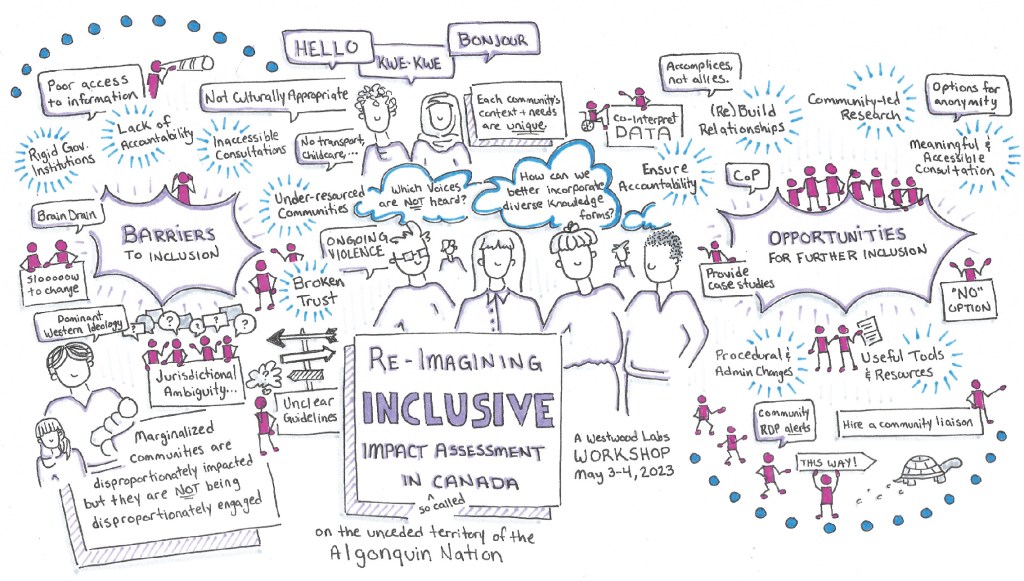
Lastly, we held a two-day workshop with employees working for the IAAC, Natural Resources Canada (NRCan), Women and Gender Equality Canada (WAGE), non-profit groups, as well as academics from various institutions to gather input on our final research question: (3) what methods and best practices can be used by proponents, IAAC, and researchers for undertaking impact prediction on small, marginalized populations while minimizing risk and harm for those populations, and how can voices of these populations be better included in IA processes?

People

Dr. Alana Westwood
PI / Supervisor,
SRES at Dalhousie University

Ali MacKellar
Lead Researcher,
SRES at Dalhousie University
Kimberly Klenk
Research Assistant,
Westwood Lab
Sasha Mines
Research Assistant,
Westwood Lab

Dr. Silas Grant
Research Co Supervisor
Research Partner
Funding and Contribution



 Westwood Lab