Congratulations to Dr. Alana Westwood, Dr. Alana Lajoie-O’Malley, Samantha Chu, and Mary Legorburu for recently being awarded highly competitive awards.
Dr. Westwood was awarded the Top Cited Article Award for the paper on “A systematic map of knowledge exchange across the science-policy interface for forest science: How can we improve consistency and effectiveness?” This paper was one of the top 10 most cited articles from 2023 in the journal Ecological Solutions & Evidence.
She also secured the SSHRC Exchange Grant for the project: What constitutes effective knowledge exchange in the science-policy interface?
This project aims to disseminate the findings of the Partnership Development Grant (PDG) project, “What constitutes effective knowledge exchange in the science-policy interface?” and provide training on effective Knowledge Exchange (KE) methods.
This will be achieved by two activities. First, informed by findings from the PDG project that subject-specific knowledge mobilization training yields better results, NGO Evidence for Democracy (E4D) will organize two capacity-building workshops on effective knowledge mobilization specific to forestry for government and university scientists involved in the PDG project. Second, based on the finding that in-person knowledge exchange activities yield better research uptake among forestry practitioners, a day-long in-person workshop will be organized on ecological forestry for foresters and forest researchers in the Maritimes to share results and use them to workshop new approaches to ongoing knowledge exchange.
Dr. Lajoie-O’Malley’s SSHRC Postdoc Project: Canadian ENGOs and the climate disinformation wars: charting new paths forward
This project aims to advance climate communications in Canada by addressing the complex interactions between evidence, democracy, and decision-making. It will draw on insights from science and technology studies (STS) and effective knowledge exchange to:
1. Investigate how Canadian environmental non-governmental organizations (ENGOs) currently engage with evidence in their climate change efforts.
2. Pilot new approaches to engaging with evidence that enhance public trust and achieve policy wins.
The project specifically seeks to develop alternative strategies for countering climate disinformation that avoid the outdated “deficit model” of science communication. This model suggests that public resistance to evidence-informed policies can be overcome simply by improving understanding of the evidence. Instead, the project will explore more effective methods of engagement that reflect the complexities of public attitudes toward climate issues.
Alana also secured a SSHRC PEG Project: ‘Just transition’ in Canada: addressing tensions, filling gaps
Researchers at Dalhousie University are collaborating with Iron and Earth, an NGO founded by fossil fuel workers, to address tensions surrounding the concept of “just transition” in Canada. Often understood to have emerged from labor groups in the 1990s advocating for a fossil fuel phase-out that protects workers’ livelihoods, the term has evolved to encompass calls from environmental justice and Indigenous rights advocates for a transition that addresses existing inequities tied to carbon-intensive industries. The meanings of “just transition” can differ significantly between champions of fossil fuel workers and these advocates. This project aims to bridge these gaps by reviewing existing literature on “just transition” from governments and civil society organizations, facilitating a social learning process among stakeholders, and producing accessible briefing materials. These resources will assist civil society actors, government officials, and others approaching just transition from various perspectives—labor, environmental justice, and Indigenous rights—in collaborating more effectively and addressing the needs of diverse communities. Additionally, public-facing materials will engage the Canadian public in discussions about the topic.
Samantha won the following awards:
1st Place, Poster Presentation Award, Poster Symposium at the CIF-IFC National Conference and AGM
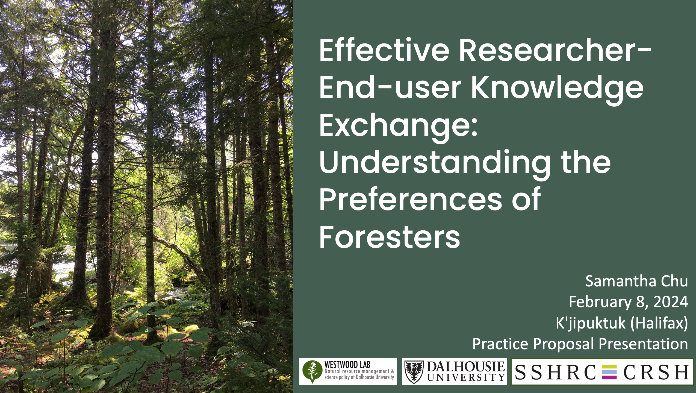
- Samantha was awarded 1st place for her poster on her research, titled Effective Researcher-End-user Knowledge Exchange: Understanding the Preferences of Foresters, at the Poster Symposium at the CIF-IFC National Conference and AGM
Neil Munro Parks and Protected Areas Award
- Samantha received the Neil Munro Parks and Protected Areas Award honours the legacy of Neil Munro, a Parks Canada employee who advocated for science-based decision-making in the management of protected areas. This award supports graduate students conducting applied research related to the planning, design, policy, protection, or management of protected areas, including national parks, provincial parks, marine protected areas, and conservation areas.
Colin Stewart Scholarship for Studies on Parks and Protected Areas in the Acadian Forest Region
- Samantha received the Colin Stewart Scholarship which supports graduate research focused on the role of parks and protected areas in conserving the ecological integrity of the Acadian forest. Named after Colin Stewart—a strong advocate for forest conservation in the Maritime Provinces—the scholarship awards applied work that contributes to sustainable forest management and highlights the ecological value of protected areas in the region.
Mary Margeret Werner Graduate Scholarship
- Samantha was awarded Mary Margaret Werner Graduate Scholarship which was given to students who demonstrate high academic achievement. Mary was a Dalhousie-trained scientist from P.E.I. who worked as a Research Scientist with Atomic Energy of Canada and later at Statistics Canada. Her work contributed to radiation biology and public health research. Known for her intelligence and dedication, she remained passionate about science throughout her life .
Canada Graduate Scholarships – SSHRC
Samantha was fortunate to receive the SSHRC-Canada Graduate Scholarship which is a prestigious federal scholarship that supports students in master’s programs in the social sciences and humanities. It recognizes academic excellence and research potential, and provides funding to help students focus on their studies and contribute to knowledge in their field.
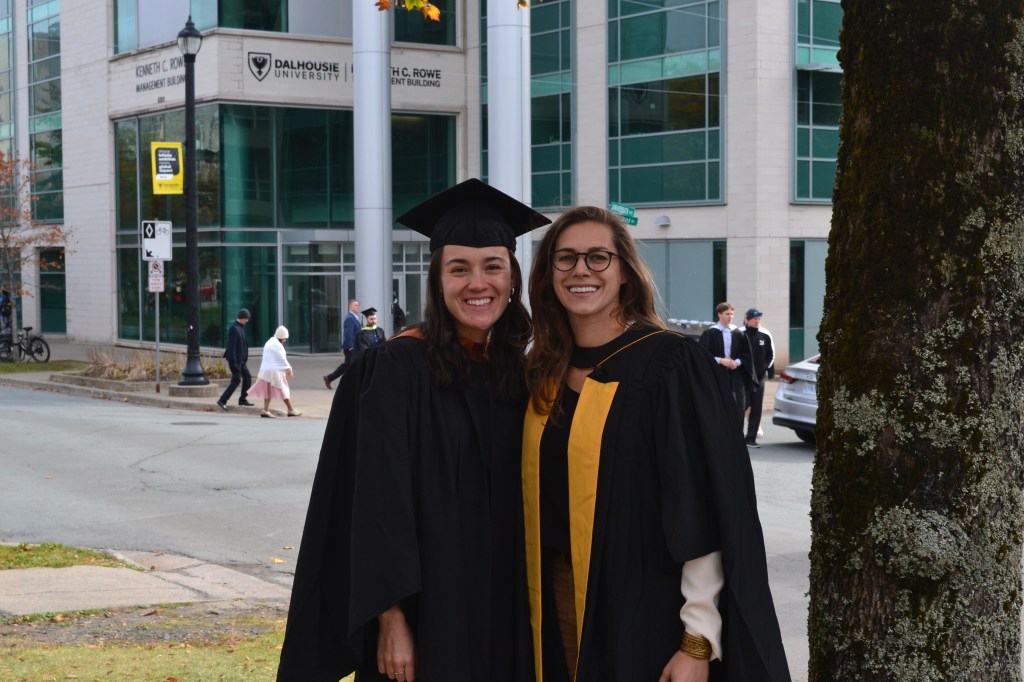
Mary was awarded the Faye Sobey Undergraduate Research Award, which established an endowment to provide deserving students the opportunity to work in a research lab.

 Westwood Lab